HomePortfolio

Publications

The discount on NAV is 53%. PEUG is changing its strategy by increasing portfolio concentration, as shown by the refocusing of its investment fund portfolio (sale of 35 funds), the disposal of shareholdings and co-investments, and the redeployment of funds into companies in priority sectors. In terms of valuation, our central scenario shows double-digit upside potential based on the current market value of listed assets.

Download PDF

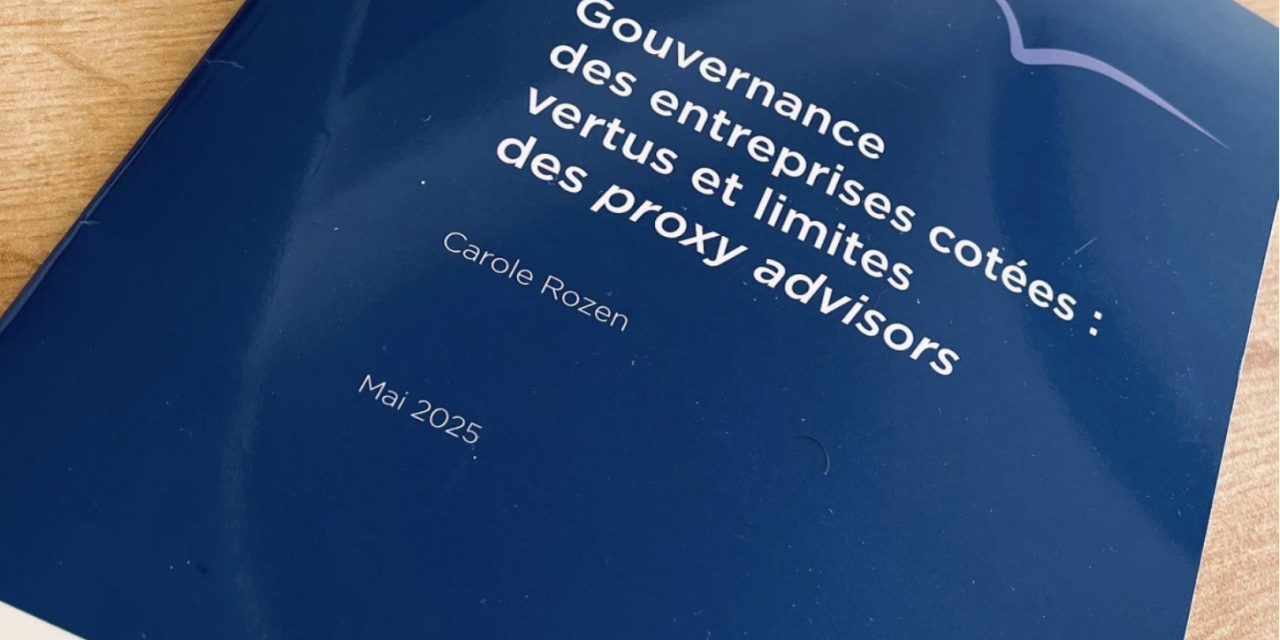
Comment sont nés les proxies ? Qui sont-ils ? Sont-ils réellement tout-puissants ? Les investisseurs peuvent-ils, et devraient-ils se passer des proxies ? Les proxiescontribuent-ils, en particulier sur le sujet de la gouvernance, sur lequel ils sont très focalisés, à des comportements des émetteurs plus respectueux de l’investisseur et de ses intérêts ? Leur travail est-il suffisamment sérieux ? Est-il contrôlé, et devrait-il l’être plus ? En somme, les proxy advisors, en centralisant l’analyse des résolutions soumises aux assemblées générales des grandes entreprises cotées et en influençant fortement le vote des investisseurs institutionnels, sont-ils devenus des acteurs utiles ou problématiques de la gouvernance d’entreprise ? Cette Note propose d’explorer ces questions à partir d’une analyse documentée et nourrie d’entretiens avec les principaux acteurs concernés – émetteurs, investis- seurs et représentants des proxies eux-mêmes.

Consultez la note en ligne

The discount to 2024 NAV remains high. The new management team is currently reviewing the portfolio, which we believe will lead to simplification and refocusing. Announcements on the evolution of the strategy are expected around the May AGM. In terms of valuation, our central scenario shows a 2-digit upside potential for listed assets at their current price.

Download the PDF

In H1-24, NAV per share came to €226.7 vs. €238.7 at the end of 2023, showing a decline of 3.7% dividend attached. This is mainly attributable to the fall in Stellantis’ share price, which reported a sharp decline in the first half of the year.`

In Europe, the automotive industry is suffering from Chinese competition, weak demand and pressure on prices. This recently prompted BMW and VW to revise their annual outlooks downwards. Against this backdrop, Stellantis shares have lost over 50% since their March highs.

In H1, PEUG carried out several disposals, generating €437m in income. The group received €369m in dividends, including €347.6m for Stellantis. Net debt fell significantly to €374m, giving an LTV of 6%. PEUG has nearly €1bn in undrawn credit lines.

Download the PDF

Despite the 59% rise in Stellantis last year, 54% of the 2023 ABR (ie. research note from 23/03/2024), PEUG’s discount is 60%, an all-time record reached in 2012/2013 when Stellantis did not exist. Is this a return to square one?

Traditionally, PEUG’s performance has been correlated with that of the car manufacturer, but this was not at all the case last year. In addition, PEUG suffered the resounding bankruptcy of Orpea, followed by that of Signa (unlisted property), which was fully written down in 2023 (€434m). In our view, these setbacks cost Chief Executive Bertrand Finet his job and probably cast a pall over the Group’s management in the minds of investors.

Download the PDF

NAV per share for H1-23 rose by 12.4%, dividends reinvested. This trend was driven by listed holdings, despite the downward revision of property assets. The year 2023 ended with a rally in the equity markets against a backdrop of falling interest rates. We are taking advantage of this movement to highlight the operating performance and prospects of 3 listed holdings that stood out. Despite the economic slowdown observed since 2023, China (and Asia) represent growth drivers for each of these 3 groups. It should be noted, however, that any downturn in Chinese growth will have a negative impact on the perception of Forvia and SEB, which have a strong presence on this continent (29% of their sales).

  • Stellantis (7.1% holding and 42.9% of GAV H1-23)
  • Forvia (3.1% holding and 1.6% GAV H1-23)
  • SEB (4.0% holding and 3.0% of GAV H1-23)

Download PDF

In H1-23, NAV per share stood at €221.3, compared with €199.5 at end-2022, up 12.4% with dividends reinvested. Listed investments outperformed the markets, thanks in particular to Stellantis (+31% ytd), the valuation of co-investments was boosted by the sale of Polyplus (gene therapy, multiple of 3.8x, IRR: 62%) to Sartorius, and that of investment funds was stable. This performance was achieved despite the downward revision of property assets (11% of the GAV at the end of 2022).

Net debt came to €862m, including €152m for the investment in Rothschild & Co in H2. LTV stood at 14%, down on H1, which bodes well for the future. It should be remembered that all debt is at a fixed rate.

The Group’s discount remains high at 54%, illustrating investors’ mistrust of investment companies with low liquidity. Management is aware of this situation and may consider buying back shares to try to reduce it. Compared with other comparable companies, PEUG’s stock market performance was satisfactory in H1-2023 (+13%).

With an unchanged discount, our central scenario shows a potential upside of 31%. Upload the report

Au S1-23, l’ANR par action s’établit à 221,3€ vs. 199,5€ fin 2022, +12,4%, dividende réinvesti. Les participations cotées affichent une performance supérieure à celle des marchés grâce notamment à Stellantis (+31% ytd), la valorisation des co-investissements est tirée par la cession de Polyplus (thérapie génique, multiple de 3,8x, TRI : 62%) à Sartorius, et celle des fonds d’investissement est stable. Cette performance a été réalisée malgré la révision en baisse des actifs immobiliers (11% de l’ABR fin 2022).

L’endettement net ressort à 862 M€ incluant 152 M€ pour l’investissement dans Rothschild & Co sur le S2. Le LTV s’inscrit à 14 %, en baisse sur le S1, ce qui est de bon augure. Rappelons que l’intégralité de la dette est à taux fixe.

La décote du groupe demeure élevée à 54% et illustre la défiance des investisseurs pour les sociétés d’investissement faiblement liquides. La direction est consciente de cette situation et pourrait envisager de racheter des titres pour tenter de la réduire. Par ailleurs et par rapport à d’autres acteurs comparables, la performance boursière de PEUG a été satisfaisante au S1-2023 (+13%).

A décote inchangée notre scenario central fait apparaître un potentiel de hausse du titre de 31%. Télécharger le PDF

Theia
Recherche

© Theia Recherche. All rights reserved.